
Dealership Website & ERP Development
Your Showroom and Your Back Office, Speaking the Same Language
A dealership runs two businesses at once: a showroom that has to move vehicles, and a back office that has to run sales, service, parts, staff and tax. We build both as one connected system, so a sale enquired about online and rung up at the counter is inventoried, invoiced, compliant and warranty-tracked in a single record.
What we build for dealerships
Scoped to your dealership — the front of house and the back office share one set of data.
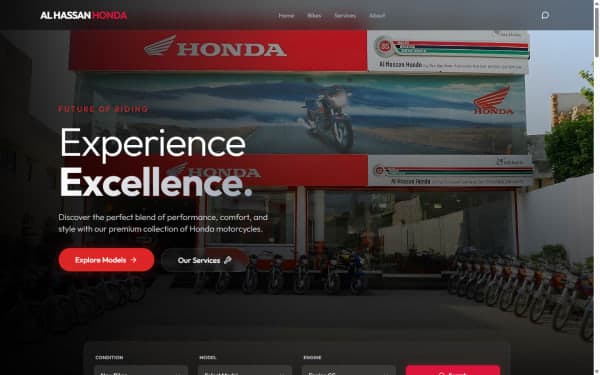
Interactive showroom website
The full line-up with category tabs, colour swatches, in-stock badges and “starting from” pricing, plus inventory search by condition, model and engine size.
Model pages that sell
A 360° viewer, per-colour variant pricing, a full spec grid, and a compare tool for weighing models side by side.
Pre-qualified enquiries
Every enquiry carries the exact model, colour and price the customer was looking at — for example a WhatsApp message pre-filled with all three.
Sales management and online sales
Deals captured and moved from first enquiry through to a recorded sale, with an online sale path where the business wants one.
Dealership ERP
HR, sales, point-of-sale, inventory and warranty management in one back office instead of spreadsheets and disconnected tools.
Tax-compliant invoicing
Point-of-sale integrated with the local tax authority’s requirements, so compliant invoices are produced at the counter.
Dealership platform we have built
Written up in full as a case study.
How dealership software gets built properly
The goal is one source of truth from the showroom page to the tax invoice.
Map the three businesses
Sales, service and spare parts each have their own flow of stock, money and paperwork. We map all three before designing a screen, because the ERP must serve them together.
Model inventory and variants
Models, variants, colours and individual units are modelled so a price difference between two colours of the same model is data, not a note.
Build the showroom on live inventory
The website reads the same inventory the counter sells from, so in-stock badges and prices are never out of date.
Make every enquiry specific
Enquiry buttons carry the model, colour and price in context, so sales staff answer a real question instead of “is this available?”.
Integrate compliance at the point of sale
Tax-authority integration and warranty registration happen as part of ringing up a sale, not as a separate end-of-month task.
Roll out by department
Each department moves onto the system with its own training and data migration, so the dealership keeps trading throughout.
What usually goes wrong with dealership systems
These are the gaps a connected build is designed to close.
A brochure website
Static pages with a contact form don’t help anyone choose a vehicle. The site works like a configurator — compare, view, price — and hands over a qualified lead.
Stock that disagrees with the website
A site maintained by hand shows sold units as available. The website reads live inventory from the ERP.
Accounting tools that don’t understand vehicles
Generic accounting software can’t model variants, chassis-level units or warranty. The ERP is built around them.
Tax compliance as an afterthought
Re-keying sales into a tax portal later invites errors and penalties. Compliance is integrated into the point of sale.
Anonymous enquiries
A blank “is this available?” message costs the sales team a round trip. Enquiries arrive pre-filled with the exact vehicle and price.
Dealership terms, in plain English
- 3S dealership
- A dealership offering Sales, Service and Spare parts under one roof — three businesses sharing customers and stock.
- DMS (dealer management system)
- Software that runs a dealership’s operations — inventory, sales, service, parts, finance and staff — from one database.
- ERP
- Enterprise resource planning: a single system connecting a business’s departments so they work from the same data.
- Variant pricing
- Different prices for versions of the same model — by colour, trim or specification — stored as structured data.
- POS (point of sale)
- Where a sale is recorded and invoiced, at the counter or online, and where tax and warranty records begin.
- Warranty management
- Registering each sold unit’s warranty and tracking claims against it through the service department.
Frequently Asked Questions
Related services
The service teams behind this kind of project.
Full-Stack Development
End-to-end product builds — web, mobile, CRM and enterprise systems delivered by one team.
Explore serviceWeb Development
Full-stack web applications with React, Next.js and Node.js, built for performance and scale.
Explore serviceData & Analytics
Business dashboards, automated reporting and predictive analytics your team will actually use.
Explore serviceConnect your showroom to your back office
Tell us how sales, service and parts run at your dealership today, and we’ll map what one connected system would replace.
Book a Call