
Real Estate & Mortgage Software Development
Proptech That Answers the Question Before Anyone Has to Ask
Which lead do I call first? What should be built on this parcel — not just what may be? What can I actually afford? We build real-estate and mortgage software around the questions agents, developers and buyers really have, using real public data and calculations that show their work.
What we build for real estate and lending
The pieces below come from proptech platforms we have designed and engineered end to end.
Brokerage CRM with AI lead scoring
Every lead scored and banded HOT, Warm or Cold, moving through stages from New to Closing, with an assistant suggesting who to call next based on behaviour.
Lead-source attribution
Leads tagged to the channel that produced them — website, Zillow, MLS, Facebook, Google, referral — so spend follows results.
Listings, contracts and disclosures
Property inventory, a contract lifecycle and automated disclosure packages managed alongside the pipeline instead of in separate tools.
Feasibility and zoning engines
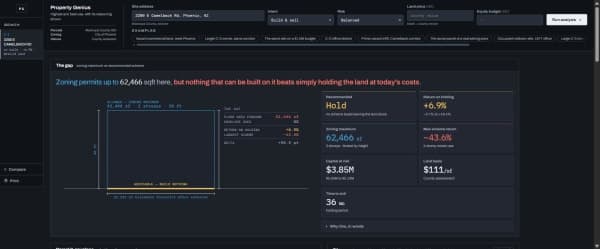
Address in, ranked development schemes out — each with a pro-forma and every zoning limit cited to the ordinance section it came from.
Mortgage guidance and calculators
Guided purchase and refinance intake with live buying power, payment breakdown, DTI and LTV — with explicit consent before any credit check.
Public-data enrichment
County GIS parcels, city zoning, and neighbourhood data from sources such as OpenStreetMap, FEMA and the U.S. Census.
Proptech platforms we have built
Each of these is written up in full as a case study.


How proptech software gets built properly
Real-estate software is judged on whether its numbers can be trusted. The sequence below protects that.
Start from the user’s first question
An agent’s is “who do I call?”; a developer’s is “what should I build?”; a buyer’s is “what can I afford?”. The first screen answers it.
Source the data honestly
Parcel, zoning and neighbourhood data come from the authoritative public source for that jurisdiction, and each figure keeps a reference to where it came from.
Compute numbers in code, not prose
Every figure is calculated deterministically and the explanatory text is assembled from those results — so the same input always gives the same answer.
Encode the paperwork
Disclosure packages and contract stages follow the real documents of the jurisdiction, so agents stop assembling them by hand.
Consent and privacy by design
Credit checks are opt-in and explained; intake collects only what the calculation needs; sensitive pipelines are role-gated.
State the limits in the product
Where coverage is partial — some districts, some counties — the software says so and declines rather than approximates.
What usually goes wrong with real-estate software
These are the mistakes that cost proptech products their users’ trust.
Quoting the zoning maximum as the answer
The largest building a zone permits is often one that can’t be parked or doesn’t pay. Schemes are sized to fit their own parking and ranked by return.
Calculators built to capture phone numbers
Buyers distrust tools that demand contact details before showing a number. Results are shown first, with the working visible.
An unsorted lead list
Hot leads cool off while agents work down a list in arrival order. Scoring and next-action suggestions put the best lead at the top.
Language models inventing figures
An AI that writes numbers can write wrong ones. Figures are computed in code; AI is used only where it cannot introduce a number.
Channels nobody can compare
Without source attribution a brokerage can’t tell Zillow leads from referrals. Source is captured on every lead from the start.
Real-estate and lending terms, in plain English
- Highest and best use
- The legally permitted, physically possible and financially viable use of a property that produces the greatest value.
- FAR (floor area ratio)
- Total building floor area divided by lot area — one of the main zoning limits on how much can be built.
- Setback
- The minimum distance a building must sit from a property line, which can increase with building height or next to residential zones.
- DTI (debt-to-income)
- Monthly debt payments divided by gross monthly income — a core measure lenders use to judge affordability.
- LTV (loan-to-value)
- The loan amount as a percentage of the property’s value; lower LTV generally means lower lender risk.
- Soft credit pull
- A credit check that doesn’t affect the borrower’s credit score, used for pre-qualification.
- Lead scoring
- Ranking leads by likelihood to transact, using signals such as listing views, recency and engagement.
Frequently Asked Questions
Related services
The service teams behind this kind of project.
SaaS Development
Multi-tenant SaaS platforms with subscription billing, onboarding and analytics baked in.
Explore serviceAI & Automation
Custom AI chatbots, lead scoring, document AI and machine learning that run in production.
Explore serviceData & Analytics
Business dashboards, automated reporting and predictive analytics your team will actually use.
Explore serviceBuilding for agents, developers or buyers?
Tell us the question your users need answered, and the data you have to answer it with. We’ll show you what a platform around it would look like.
Book a Call